🧭 Data Science Career Guide - 2026: Complete Roadmap to Mastery
The data science field in 2026 presents unprecedented opportunities. Specialists with production deployment skills command premium salaries while generalist roles face intense competition!
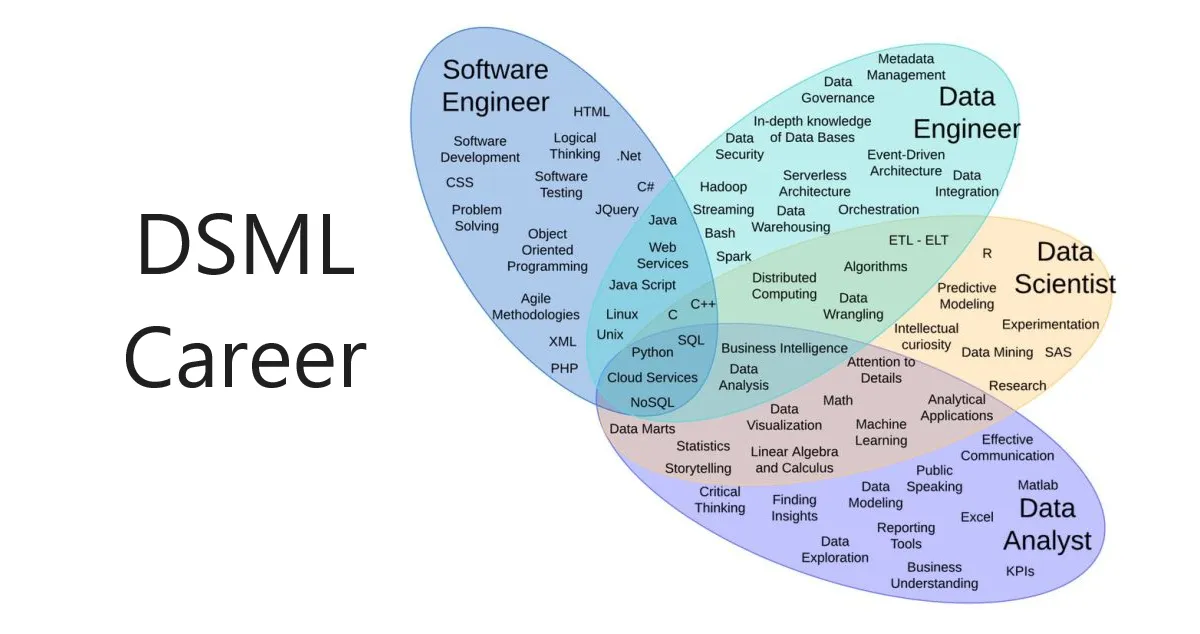
Executive Summary
The data science field in 2026 presents unprecedented opportunities with a 34% projected growth (2024-2034) according to the U.S. Bureau of Labor Statistics. However, the market has become bifurcated: specialists with production deployment skills command premium salaries while generalist roles face intense competition.
Critical Market Reality:
- Demand exceeds supply by 50%+ in the US by 2026
- 11.5 million new data roles projected by late 2026
- Average salary: $120,000-$129,000 for Data Scientists
- 68% of job postings now require multi-cloud expertise
Key Insight: Companies aren’t hiring “model builders” — they’re hiring data scientists who can ship, monitor, and productionize models end-to-end.
Part 1: In-Demand Skills Analysis (2026)
📊 Top Skills Ranking
Based on analysis of 700+ job postings in 2026, here are the most in-demand skills:
| Rank | Skill | Prevalence | Change from 2025 | Priority |
|---|---|---|---|---|
| 1 | Statistics & ML | 92% | Stable | ⭐⭐⭐⭐⭐ |
| 2 | Communication | 86% | ↑ (+15pp) | ⭐⭐⭐⭐⭐ |
| 3 | Python | 82% | ↓ (from #2) | ⭐⭐⭐⭐⭐ |
| 4 | SQL | 79% | ↑ (+18pp) | ⭐⭐⭐⭐⭐ |
| 5 | ETL/Pipelines | 31% | ↑ (+18pp) | ⭐⭐⭐⭐ |
| 6 | Snowflake | 21% | ↑ (+10pp) | ⭐⭐⭐⭐ |
| 7 | dbt | 19% | ↑ (+9pp) | ⭐⭐⭐⭐ |
| 8 | Cloud (AWS/Azure/GCP) | 68% | Stable | ⭐⭐⭐⭐⭐ |
| 9 | Docker/Kubernetes | 45% | ↑ | ⭐⭐⭐⭐ |
| 10 | GenAI/LLMs | 89% | NEW | ⭐⭐⭐⭐⭐ |
🔄 Skills with Declining Demand
| Skill | 2025 | 2026 | Trend | Alternative |
|---|---|---|---|---|
| SAS | 15% | 2% | ↓↓↓ | Python (Pandas, scikit-learn) |
| MATLAB | 5% | 0% | ↓↓↓ | Python (NumPy, SciPy) |
| Scala | 9% | 1% | ↓↓ | Python, SQL warehouses |
| R | 50% | 41% | ↓ | Python (still viable in academia) |
| Hadoop | 12% | 3% | ↓↓ | Snowflake, BigQuery, Spark |
Note: R at 41% is still significant, especially in biostatistics, clinical trials, and academia. Not dead, just specialized.
Part 2: Programming Languages Deep Dive
Python vs R vs Julia: Career ROI Analysis
Python 🐍
Market Share: #1 (78% of job postings explicitly mention Python)
Best For:
- General-purpose data science
- Production ML systems
- Deep learning & AI
- MLOps & deployment
- Web scraping & automation
Ecosystem:
- Data: Pandas, Polars, Ibis (replacing Pandas), NumPy
- ML: scikit-learn, XGBoost, LightGBM
- Deep Learning: PyTorch, TensorFlow, Keras
- GenAI: LangChain, LangGraph, llama-index
- Deployment: FastAPI, Flask, Streamlit
Salary Impact: Standard baseline (reference point)
When to Choose:
- First language for data science
- Production deployment is priority
- AI/GenAI development
- Startup/tech company focus
R 📊
Market Share: #2-3 (41% of job postings in 2026, down from 50%)
Best For:
- Statistical analysis & research
- Clinical trials & pharma
- Academic research
- Advanced visualization
- Regulatory reporting (FDA prefers R)
Ecosystem:
- Data: dplyr, tidyr, data.table
- Visualization: ggplot2 (industry gold standard)
- Stats: Over 18,000 CRAN packages
- ML: caret, mlr3
Salary Impact: +0-5% in specialized roles (biostatistics, pharma)
When to Choose:
- Healthcare/pharmaceutical industry
- Academic or research institution
- Statistical consulting
- Exploratory data analysis (EDA) focus
Critical Insight: The best data scientists in 2026 are bilingual — Python for pipelines/deployment, R for deep statistical analysis and publication-quality visualizations.
Julia ⚡
Market Share: Niche (<1% of general postings, but 500-800 specialized roles)
Best For:
- High-performance computing
- Quantitative finance
- Scientific computing
- Novel algorithm development
- Physics simulations
Ecosystem:
- Speed: JIT compilation → C-level performance
- Data: DataFrames.jl, TidierData.jl
- ML: Flux.jl, MLJ.jl
- Interop: Call Python, R, C, Fortran libraries
Salary Impact: +10-20% in specialized roles (quant finance, HPC)
When to Choose:
- Hedge funds & algorithmic trading
- Climate modeling
- Computational physics
- Performance is critical bottleneck
Job Market Reality:
- Python: ~300,000-400,000 global openings
- R: ~80,000-120,000 global openings
- Julia: ~500-800 specialized openings
Part 3: Cloud Platforms Comparison
AWS vs Azure vs GCP: Strategic Choice Matrix
| Factor | AWS | Azure | GCP |
|---|---|---|---|
| Market Share | 31% | 23-25% | 11-12% |
| Job Openings | ~55,000 | ~42,000 | ~20,000 |
| Avg Salary | Baseline | +5-8% | +10-15% |
| Best For | Startups, general purpose | Enterprise, Microsoft stack | AI/ML, data analytics |
| Learning Curve | Moderate (200+ services) | Steep (Microsoft ecosystem) | Easier (focused tools) |
| AI/ML Tools | SageMaker, Bedrock | Azure ML + OpenAI exclusive | Vertex AI, TPUs, BigQuery ML |
| Certifications | Most recognized | Enterprise value | Specialized premium |
| Multi-Cloud | 42% of jobs require 2+ clouds | 42% of jobs require 2+ clouds | 42% of jobs require 2+ clouds |
Recommendations by Career Path
graph TD
    A[Choose Your Path] --> B{Industry Focus?}
    B -->|Startups/Tech| C[AWS - Broadest opportunities]
    B -->|Enterprise/Banking| D[Azure - Microsoft integration]
    B -->|AI/Data-Heavy| E[GCP - Best AI tools]

    C --> F[Then add: Azure or GCP]
    D --> G[Then add: AWS or GCP]
    E --> H[Then add: AWS]

    F --> I[Multi-Cloud Premium: +18-25% salary]
    G --> I
    H --> I
Platform-Specific Strengths
AWS (Start Here for Most):
- Largest ecosystem & community
- Most job opportunities (2.5x vs GCP)
- Best documentation & learning resources
- Services: EC2, S3, Lambda, SageMaker
Azure (Enterprise Focus):
- Microsoft 365 deep integration
- Exclusive OpenAI partnership (GPT-4, GPT-5)
- Best for organizations using: Office 365, Active Directory, .NET
- Growing fastest in absolute revenue
GCP (AI/Data Specialists):
- Best AI/ML tools: Vertex AI, AutoML, TPUs
- BigQuery: Industry-leading data warehouse
- GKE: Best managed Kubernetes (Google invented K8s)
- Private global fiber network
Strategy: Learn AWS first (job volume), then add GCP or Azure for multi-cloud premium.
Part 4: Modern Data Stack Alternatives
Data Manipulation Tools
| Category | Traditional | Modern Alternative | Why Switch? |
|---|---|---|---|
| Python Data | Pandas | Polars or Ibis | 5-10x faster, better syntax |
| Package Mgmt | pip/poetry | uv | All-in-one, blazing fast |
| Notebooks | Jupyter | Positron IDE | Best of RStudio + VS Code |
| R Data | base R | dplyr/tidyverse | Readable, chainable syntax |
BI & Visualization
| Tool | Use Case | Learning Priority | Job Market |
|---|---|---|---|
| Tableau | Enterprise BI, drag-drop | ⭐⭐⭐⭐ | High demand |
| Power BI | Microsoft ecosystem | ⭐⭐⭐⭐ | Growing fast |
| Looker | Data modeling, SQL-based | ⭐⭐⭐ | Medium |
| Matplotlib/Seaborn | Code-based (Python) | ⭐⭐⭐⭐⭐ | Essential |
| ggplot2 | Code-based (R) | ⭐⭐⭐⭐ | R users |
| Plotly | Interactive dashboards | ⭐⭐⭐ | Growing |
Part 5: Job Roles & Career Progression
Role-by-Role Analysis
1. Data Analyst (Entry Point)
| Aspect | Details |
|---|---|
| Salary Range | $52,918 - $137,310/year (Entry: $68,892 - $81,000) |
| Priority Level | ⭐⭐⭐⭐ HIGH - Best entry point |
| Core Skills | SQL (79%), Python/R, Excel, BI Tools, Statistics |
| Career Path | Junior → Senior Analyst → BI Analyst → Analytics Manager → Data Scientist |
| Growth Outlook | 108,400 new jobs next decade |
| Time to Competency | 3-6 months for basics |
Key Responsibilities:
- Analyze data to answer business questions
- Create dashboards and reports
- Identify trends and patterns
- Communicate insights to stakeholders
2. Data Scientist (Core Role)
| Aspect | Details |
|---|---|
| Salary Range | $78,361 - $209,740/year (Avg: $120,000-$129,000) |
| Priority Level | ⭐⭐⭐⭐⭐ CRITICAL - Highest strategic value |
| Core Skills | Stats & ML (92%), Communication (86%), Python (82%), SQL (79%) |
| Career Path | Junior → Mid → Senior → Lead → DS Manager → Chief Data Officer |
| Growth Outlook | 34% growth, 23,400 openings/year |
| Time to Competency | 6-12 months intensive study |
2026 Market Reality:
- Must own projects end-to-end (not just modeling)
- Production deployment skills now mandatory
- Data engineering knowledge essential
- Communication ranked #2 (above Python!)
3. Machine Learning Engineer (Production Focus)
| Aspect | Details |
|---|---|
| Salary Range | $113,000 - $310,009/year |
| Priority Level | ⭐⭐⭐⭐⭐ CRITICAL - Deployment skills in highest demand |
| Core Skills | Python/Java, ML, TensorFlow/PyTorch, MLOps, Docker/K8s, Cloud |
| Career Path | Junior MLE → Senior → Staff → Principal → ML Manager |
| Growth Outlook | Fastest growing specialization |
Critical Differentiator: Not about model building — about shipping to production.
4. Data Engineer (Foundation)
| Aspect | Details |
|---|---|
| Salary Range | $88,216 - $211,050/year |
| Priority Level | ⭐⭐⭐⭐⭐ CRITICAL - Foundation for all DS work |
| Core Skills | SQL, Python, Spark, ETL (+18%), Snowflake (+10%), dbt (+9%), Airflow |
| Growth Trend | Data scientists now expected to have DE skills |
Why Demand Surged: Companies expect DS to work directly with data infrastructure, not just consume clean tables.
5. Generative AI Developer (Emerging Critical)
| Aspect | Details |
|---|---|
| Salary Range | $135,000 - $200,000/year |
| Priority Level | ⭐⭐⭐⭐⭐ EMERGING CRITICAL - Fastest growth |
| Core Skills | LLMs, LangChain, LangGraph, Prompt Engineering, RAG, Vector DBs |
| Market Reality | GenAI mentioned in 89% of job postings |
Critical: GenAI is now baseline expectation, not a specialization.
6. AI Research Engineer
| Aspect | Details |
|---|---|
| Salary Range | $130,000 - $250,000/year |
| Priority Level | ⭐⭐⭐⭐ HIGH - Requires advanced education |
| Core Skills | PyTorch/TensorFlow, Research methodology, Model optimization |
| Best For | PhDs, research labs, cutting-edge work |
Part 6: 12-Month Mastery Roadmap
Phase 1: Foundation (Months 1-3) ⭐⭐⭐⭐⭐
Priority: HIGHEST - Everything depends on this
Month 1: Python & SQL
Week 1-2: Python Fundamentals
- Variables, data types, loops, functions
- Object-Oriented Programming (OOP) basics
- Virtual environments, modules, packages
- Project: 3 mini-projects (calculator, file processor, web scraper)
Week 2-4: SQL Mastery
- JOINs, subqueries, CTEs
- Window functions:
ROW_NUMBER,RANK,LAG,LEAD,SUM OVER - Aggregations,
GROUP BY,HAVING - Practice: 30 SQL challenges (LeetCode, HackerRank)
Resources:
Month 2: Data Manipulation & Statistics
Week 1-2: Pandas & NumPy
1
2
3
4
5
6
7
8
9
10
11
12
13
14
15
16
17
18
import pandas as pd
import numpy as np

# Essential operations
df = pd.read_csv('data.csv')
df.head()
df.info()
df.describe()

# Data cleaning
df.dropna()
df.fillna(method='ffill')

# Grouping
df.groupby('category').agg({'sales': 'sum'})

# Joining
pd.merge(df1, df2, on='key', how='left')
Week 3-4: Statistics Fundamentals
- Descriptive statistics: mean, median, mode, std dev
- Probability distributions: Normal, Binomial, Poisson
- Hypothesis testing, p-values, confidence intervals
- Correlation vs. causation
Project: 5 data cleaning exercises, statistical analysis report
Month 3: Git, EDA & Visualization
Week 1: Version Control
1
2
3
4
5
6
7
git init
git add .
git commit -m "Initial commit"
git branch feature-xyz
git checkout feature-xyz
git merge main
git push origin main
Week 2-3: Exploratory Data Analysis
1
2
3
4
5
6
7
8
9
10
11
12
import matplotlib.pyplot as plt
import seaborn as sns

# Distribution plots
sns.histplot(data=df, x='column')
sns.boxplot(data=df, x='category', y='value')

# Correlation heatmap
sns.heatmap(df.corr(), annot=True)

# Scatter plots
sns.scatterplot(data=df, x='feature1', y='feature2', hue='category')
Week 4: Project Alpha
- End-to-end SQL + Python + EDA project
- Example: Analyze public mobility/transportation data
- Deliverable: GitHub repo with detailed README
Phase 2: Machine Learning (Months 4-7) ⭐⭐⭐⭐⭐
Priority: CRITICAL - Core differentiator
Month 4-5: Classical Machine Learning
Supervised Learning:
1
2
3
4
5
6
7
8
9
10
11
12
13
14
15
from sklearn.model_selection import train_test_split
from sklearn.linear_model import LogisticRegression
from sklearn.ensemble import RandomForestClassifier
from sklearn.metrics import accuracy_score, classification_report

# Train-test split
X_train, X_test, y_train, y_test = train_test_split(X, y, test_size=0.2)

# Model training
model = RandomForestClassifier(n_estimators=100)
model.fit(X_train, y_train)

# Evaluation
y_pred = model.predict(X_test)
print(classification_report(y_test, y_pred))
Algorithms to Master:
- Linear & Logistic Regression
- Decision Trees & Random Forests
- Gradient Boosting (XGBoost, LightGBM, CatBoost)
- Support Vector Machines (SVM)
- K-Nearest Neighbors (KNN)
Unsupervised Learning:
- K-Means Clustering
- DBSCAN
- Principal Component Analysis (PCA)
- t-SNE for visualization
Model Evaluation:
- Train/test splits, cross-validation
- Metrics: Accuracy, Precision, Recall, F1, ROC-AUC, RMSE, MAE
- Confusion matrices
- Overfitting vs. underfitting
Project Beta: Customer retention prediction model
Month 6-7: Feature Engineering & Tuning
Feature Engineering (70% of ML work):
1
2
3
4
5
6
7
8
9
10
11
# Categorical encoding
from sklearn.preprocessing import OneHotEncoder, LabelEncoder

# Scaling
from sklearn.preprocessing import StandardScaler, MinMaxScaler
scaler = StandardScaler()
X_scaled = scaler.fit_transform(X)

# Feature creation
df['total_price'] = df['quantity'] * df['unit_price']
df['month'] = pd.to_datetime(df['date']).dt.month
Hyperparameter Tuning:
1
2
3
4
5
6
7
8
9
10
11
from sklearn.model_selection import GridSearchCV

param_grid = {
    'n_estimators': [100, 200, 300],
    'max_depth': [10, 20, 30],
    'min_samples_split': [2, 5, 10]
}

grid = GridSearchCV(RandomForestClassifier(), param_grid, cv=5)
grid.fit(X_train, y_train)
best_model = grid.best_estimator_
Deliverable: Kaggle competition entry (top 50%)
Phase 3: Production Skills (Months 8-10) ⭐⭐⭐⭐⭐
Priority: HIGHEST - Market demands deployment skills
Month 8: Data Engineering Essentials
Modern Data Stack (+18% demand in 2026):
Snowflake/BigQuery Fundamentals:
1
2
3
4
5
6
7
8
9
10
11
12
13
14
15
16
17
-- Create data warehouse
CREATE DATABASE analytics;
CREATE SCHEMA staging;

-- Load data
COPY INTO staging.users
FROM @my_s3_stage
FILE_FORMAT = (TYPE = CSV);

-- Transformations with dbt
-- models/staging/stg_users.sql
SELECT
    user_id,
    email,
    created_at::DATE as signup_date
FROM
WHERE email IS NOT NULL
Airflow for Orchestration:
1
2
3
4
5
6
7
8
9
10
11
12
13
14
15
16
17
18
from airflow import DAG
from airflow.operators.python import PythonOperator
from datetime import datetime

def extract_data():
    # Extract logic
    pass

def transform_data():
    # Transform logic
    pass

dag = DAG('etl_pipeline', start_date=datetime(2026, 1, 1), schedule_interval='@daily')

extract = PythonOperator(task_id='extract', python_callable=extract_data, dag=dag)
transform = PythonOperator(task_id='transform', python_callable=transform_data, dag=dag)

extract >> transform
Deliverable: ETL pipeline documentation
Month 9: MLOps & Deployment
Docker Containerization:
1
2
3
4
5
6
7
8
FROM python:3.11-slim

WORKDIR /app
COPY requirements.txt .
RUN pip install --no-cache-dir -r requirements.txt

COPY . .
CMD ["python", "app.py"]
FastAPI for Model Serving:
1
2
3
4
5
6
7
8
9
10
from fastapi import FastAPI
import joblib

app = FastAPI()
model = joblib.load('model.pkl')

@app.post("/predict")
def predict(features: dict):
    prediction = model.predict([list(features.values())])
    return {"prediction": prediction[0]}
Cloud Deployment:
- AWS: EC2, S3, SageMaker
- GCP: Compute Engine, Cloud Run, Vertex AI
- Azure: VM, Blob Storage, Azure ML
CI/CD Pipeline (GitHub Actions):
1
2
3
4
5
6
7
8
9
10
11
name: ML Pipeline
on: [push]
jobs:
  train-deploy:
    runs-on: ubuntu-latest
    steps:
      - uses: actions/checkout@v2
      - name: Train model
        run: python train.py
      - name: Deploy to cloud
        run: ./deploy.sh
Deliverable: Deployed ML API on cloud platform
Month 10: GenAI & LLM Applications
Essential GenAI Skills (89% of postings):
LangChain Basics:
1
2
3
4
5
6
7
8
9
10
11
12
from langchain.llms import OpenAI
from langchain.chains import LLMChain
from langchain.prompts import PromptTemplate

llm = OpenAI(temperature=0.7)
prompt = PromptTemplate(
    input_variables=["product"],
    template="Generate a description for {product}"
)

chain = LLMChain(llm=llm, prompt=prompt)
result = chain.run("smart watch")
RAG Implementation:
1
2
3
4
5
6
7
8
9
10
11
12
13
14
15
from langchain.vectorstores import Chroma
from langchain.embeddings import OpenAIEmbeddings
from langchain.document_loaders import TextLoader

# Load documents
loader = TextLoader('docs/')
documents = loader.load()

# Create vector store
embeddings = OpenAIEmbeddings()
vectorstore = Chroma.from_documents(documents, embeddings)

# Query
query = "What is the refund policy?"
docs = vectorstore.similarity_search(query)
Vector Databases:
- ChromaDB (local development)
- Pinecone (production)
- Weaviate (hybrid search)
Project Gamma: RAG application - “Chat with Company Policy”
Phase 4: Specialization & Portfolio (Months 11-12) ⭐⭐⭐⭐
Month 11: Choose Your Specialization
Option A: Deep Learning & Computer Vision
- Neural networks, CNNs, Transfer Learning
- PyTorch/TensorFlow in depth
- Image classification, object detection
- Project: Image classifier or object detector
Option B: Natural Language Processing
- Transformers, BERT, GPT architectures
- Text preprocessing, tokenization, embeddings
- Sentiment analysis, named entity recognition
- Project: NLP pipeline or chatbot
Option C: Time Series & Forecasting
- ARIMA, Prophet, LSTM for sequences
- Anomaly detection
- Demand forecasting
- Project: Sales forecasting or anomaly detector
Month 12: Capstone Project
Requirements for Production-Ready System:
- ✅ Cloud-hosted (AWS/GCP/Azure)
- ✅ FastAPI backend with error handling
- ✅ Database integration (PostgreSQL/MongoDB)
- ✅ Monitoring & logging (MLflow/LangSmith)
- ✅ CI/CD pipeline (GitHub Actions)
- ✅ Professional documentation (README, API docs)
- ✅ Deployed and accessible via URL
Example: Real-time fraud detection system, recommendation engine, or predictive maintenance dashboard
Part 7: Critical Success Factors (2026)
1. End-to-End Project Ownership
The 2026 market shows clear shift: companies want data scientists who can own projects from conception to production.
What This Means:
- Understand business problem first
- Extract and prepare own data (DE skills)
- Build and validate models
- Deploy to production
- Monitor performance and iterate
- Communicate results to stakeholders
2. Communication Skills (Now #2 Most Requested)
Communication jumped from #3 (2025) to #2 (2026) in job postings.
Develop These Skills:
- Write clear, jargon-free reports
- Create compelling data visualizations
- Present to non-technical audiences
- Document code and processes
- Tell stories with data
3. Production Deployment (Critical Differentiator)
“Companies aren’t hiring model builders — they’re hiring data scientists who can ship, monitor, and productionize models end-to-end.”
Essential Production Skills:
- Docker & containerization
- Cloud platforms (AWS/GCP/Azure)
- API development (FastAPI/Flask)
- Model monitoring
- CI/CD pipelines
4. GenAI Baseline Knowledge
GenAI is no longer specialization — it’s baseline expectation.
Minimum Competencies:
- Understand how LLMs work
- Effective prompt engineering
- API integration with LLM providers
- Basic RAG implementation
Part 8: Career Progression Timeline
Typical Career Path
graph LR
    A[0-1 yr: Junior] --> B[2-3 yr: Mid-level]
    B --> C[4-6 yr: Senior]
    C --> D[7-10 yr: Lead/Staff]
    D --> E[10+ yr: Manager/Director/CDO]

    style A fill:#ffd700
    style B fill:#87ceeb
    style C fill:#98fb98
    style D fill:#dda0dd
    style E fill:#ff6347
| Years | Level | Key Focus | Expected Capabilities | Salary Range |
|---|---|---|---|---|
| 0-1 | Junior/Entry | Learn tools, execute tasks | SQL, Python, basic ML, docs | $70K-$90K |
| 2-3 | Mid-level | Own projects independently | Advanced ML, deployment, stakeholder mgmt | $100K-$130K |
| 4-6 | Senior | Define problems, mentor | Problem scoping, tech leadership, impact | $130K-$180K |
| 7-10 | Lead/Staff | Set direction, influence | Architecture, team building, ROI | $180K-$250K |
| 10+ | Manager/Director/CDO | Strategy, team scaling | Budget, hiring, cross-functional | $200K-$400K+ |
Advancement Strategies
1. Build Track Record of Impact
- Keep running doc of analyses → decisions
- Quantify: revenue ↑, costs ↓, time saved
2. Mentor and Lead
- Review junior work
- Onboard new team members
- Lead technical discussions
3. Own Projects End-to-End
- Volunteer for strategic projects
- Demonstrate production capability
4. Develop Domain Expertise
- Healthcare, finance, retail depth
- Industry-specific regulations
Part 9: Industry-Specific Opportunities
High-Growth Industries for Data Science
| Industry | Market Value/Growth | Key Applications | Priority |
|---|---|---|---|
| Healthcare | $84.2B by 2027 Fastest growing | Predictive outcomes, genomics, disease risk | ⭐⭐⭐⭐⭐ |
| Finance | $1.3T annual value | Fraud detection, risk, trading, credit | ⭐⭐⭐⭐⭐ |
| Supply Chain | 26.5% market share 2026 | Demand forecasting, optimization | ⭐⭐⭐⭐ |
| Manufacturing | $3.55B by 2026 (21.6% CAGR) | Predictive maintenance, quality | ⭐⭐⭐⭐ |
| E-commerce | 23x more likely to acquire | Recommendations, personalization | ⭐⭐⭐⭐ |
Industry Selection Strategy:
- Healthcare: Best growth, requires domain knowledge
- Finance: Highest pay, strict regulations
- Tech/Startups: Most innovative, fast-paced
- Retail/E-commerce: High volume, immediate impact
Appendix: Skills Mastery Summary Tables
A. Core Technical Skills Priority Matrix
| Skill Category | Specific Skills | Mastery Timeline | Priority | Job Market Demand |
|---|---|---|---|---|
| Programming | Python | 1-2 months | ⭐⭐⭐⭐⭐ | 82% of postings |
| SQL | 1 month | ⭐⭐⭐⭐⭐ | 79% of postings | |
| R | 2-3 months | ⭐⭐⭐ | 41% (specialized) | |
| Data Manipulation | Pandas/Polars | 2 weeks | ⭐⭐⭐⭐⭐ | Essential |
| NumPy | 1 week | ⭐⭐⭐⭐ | Essential | |
| dplyr (R) | 1 week | ⭐⭐⭐ | R users only | |
| Statistics & Math | Descriptive stats | 1 month | ⭐⭐⭐⭐⭐ | 92% of postings |
| Probability | 2 weeks | ⭐⭐⭐⭐⭐ | Essential | |
| Linear algebra | 1 month | ⭐⭐⭐⭐ | Deep learning | |
| Machine Learning | Classical ML | 2-3 months | ⭐⭐⭐⭐⭐ | 69% of postings |
| Deep learning | 2-3 months | ⭐⭐⭐⭐ | Advanced roles | |
| MLOps | 1-2 months | ⭐⭐⭐⭐⭐ | Production focus | |
| Data Engineering | ETL/Pipelines | 1 month | ⭐⭐⭐⭐⭐ | +18% in 2026 |
| Snowflake/BigQuery | 2-3 weeks | ⭐⭐⭐⭐ | +10% in 2026 | |
| dbt | 1-2 weeks | ⭐⭐⭐⭐ | +9% in 2026 | |
| Airflow | 2 weeks | ⭐⭐⭐⭐ | Growing | |
| Cloud Platforms | AWS | 1-2 months | ⭐⭐⭐⭐⭐ | 68% combined |
| Azure | 1-2 months | ⭐⭐⭐⭐ | Enterprise focus | |
| GCP | 1-2 months | ⭐⭐⭐⭐ | AI/ML focus | |
| Deployment | Docker | 2 weeks | ⭐⭐⭐⭐⭐ | 45% of postings |
| Kubernetes | 1 month | ⭐⭐⭐⭐ | Production | |
| FastAPI/Flask | 1 week | ⭐⭐⭐⭐⭐ | API deployment | |
| GenAI | LLMs/Prompt eng | 2-4 weeks | ⭐⭐⭐⭐⭐ | 89% of postings |
| LangChain/LangGraph | 2-3 weeks | ⭐⭐⭐⭐⭐ | Emerging critical | |
| RAG systems | 1-2 weeks | ⭐⭐⭐⭐ | Growing fast | |
| Vector databases | 1 week | ⭐⭐⭐⭐ | RAG requirement | |
| Visualization | Matplotlib/Seaborn | 1-2 weeks | ⭐⭐⭐⭐⭐ | Python essential |
| Tableau | 2-3 weeks | ⭐⭐⭐⭐ | Enterprise BI | |
| Power BI | 2-3 weeks | ⭐⭐⭐⭐ | Microsoft stack |
B. Soft Skills Priority Matrix
| Soft Skill | Importance 2026 | Development Time | Practice Methods |
|---|---|---|---|
| Communication | ⭐⭐⭐⭐⭐ (#2 skill) | Ongoing | Presentations, blog posts, documentation |
| Problem-solving | ⭐⭐⭐⭐⭐ | Ongoing | Kaggle, real projects |
| Critical thinking | ⭐⭐⭐⭐⭐ | Ongoing | Case studies, peer review |
| Collaboration | ⭐⭐⭐⭐ | Ongoing | Team projects, open source |
| Business acumen | ⭐⭐⭐⭐ | 3-6 months | Industry reading, stakeholder work |
| Adaptability | ⭐⭐⭐⭐ | Continuous | Learning new tools quickly |
C. Learning Resources Comparison
| Platform | Best For | Cost | Time Investment | Certificate Value |
|---|---|---|---|---|
| DataCamp | Interactive, beginner-friendly | $25-39/mo | 2-4 hrs/week | ⭐⭐⭐ |
| Coursera | University courses, depth | $49-79/mo | 5-10 hrs/week | ⭐⭐⭐⭐ |
| 365 Data Science | Full curriculum, career support | $29/mo | 3-5 hrs/week | ⭐⭐⭐ |
| Kaggle | Practice, competitions | Free | Varies | ⭐⭐⭐⭐ |
| Fast.ai | Practical deep learning | Free | 10+ hrs/week | ⭐⭐⭐ |
| YouTube | Supplementary learning | Free | As needed | ⭐⭐ |
| Books | Deep understanding | $30-60 | Self-paced | ⭐⭐⭐⭐ |
D. Tool Alternatives Quick Reference
| Need | Primary Tool | Alternative 1 | Alternative 2 | When to Use Alternative |
|---|---|---|---|---|
| Language | Python | R | Julia | R: Stats/academia Julia: HPC/quant finance |
| Data Wrangling | Pandas | Polars | Ibis | Polars: Speed Ibis: Multi-backend |
| ML Library | scikit-learn | XGBoost | LightGBM | XGBoost: Competitions LightGBM: Speed |
| Deep Learning | PyTorch | TensorFlow | JAX | TF: Production JAX: Research |
| Cloud | AWS | Azure | GCP | Azure: Microsoft GCP: AI/Data |
| Notebook | Jupyter | Positron IDE | Pluto (Julia) | Positron: Best of both Pluto: Reactive |
| BI Tool | Tableau | Power BI | Looker | Power BI: Microsoft Looker: SQL-based |
| Version Control | Git/GitHub | GitLab | Bitbucket | GitLab: CI/CD integrated |
E. Certification ROI Analysis
| Certification | Cost | Study Time | Salary Impact | Best For |
|---|---|---|---|---|
| AWS Certified Machine Learning | $300 | 40-60 hrs | +$5K-10K | Cloud ML deployment |
| Google Professional Data Engineer | $200 | 50-80 hrs | +$8K-12K | GCP data pipelines |
| Azure Data Scientist Associate | $165 | 30-50 hrs | +$5K-8K | Azure ML workflows |
| TensorFlow Developer | $100 | 40-60 hrs | +$3K-5K | Deep learning roles |
| Databricks Certified | $200 | 20-40 hrs | +$5K-10K | Spark/big data |
Final Recommendations
The 2026 Data Science Success Formula
Phase 1 (Months 0-3): Foundation
- Master Python + SQL (non-negotiable)
- Build statistical foundation
- Create 3-5 portfolio projects
- Investment: 2-3 hrs/day
Phase 2 (Months 4-7): Machine Learning
- Classical ML algorithms
- Feature engineering (70% of work)
- Model evaluation mastery
- Investment: 3-4 hrs/day
Phase 3 (Months 8-10): Production
- Data engineering essentials
- MLOps & deployment
- GenAI/LLM applications
- Investment: 4-5 hrs/day
Phase 4 (Months 11-12): Specialization
- Choose: Deep Learning, NLP, or Time Series
- Build capstone production system
- Polish portfolio & resume
- Investment: 5+ hrs/day
Career Strategy
Immediate (First 6 months):
- ✅ Learn Python + SQL to competency
- ✅ Complete 30 SQL challenges
- ✅ Build 3 end-to-end projects
- ✅ Start contributing to open source
Short-term (6-12 months):
- ✅ Master classical ML
- ✅ Deploy first production model
- ✅ Learn AWS or GCP fundamentals
- ✅ Build impressive GitHub portfolio
Medium-term (1-2 years):
- ✅ Specialize in high-demand area (GenAI, MLOps)
- ✅ Contribute to major open source projects
- ✅ Write technical blog posts
- ✅ Speak at meetups/conferences
Long-term (2-5 years):
- ✅ Become bilingual (Python + R or Python + Julia)
- ✅ Multi-cloud expertise (AWS + GCP/Azure)
- ✅ Deep domain knowledge (healthcare, finance, etc.)
- ✅ Mentor others, build personal brand
Resources
Essential Books
- Fundamentals of Data Engineering - Joe Reis, Matt Housley
- Hands-On Machine Learning - Aurélien Géron
- Python for Data Analysis - Wes McKinney
- Designing Machine Learning Systems - Chip Huyen
Practice Platforms
- LeetCode: SQL and Python challenges
- HackerRank: Algorithms and data structures
- Kaggle: Real-world datasets and competitions
- StrataScratch: FAANG interview questions
Communities
- r/datascience on Reddit
- Data Science Central
- Kaggle Forums
- LinkedIn Data Science Groups
Conferences (2026)
- NeurIPS, ICML, KDD (research)
- Strata Data Conference (industry)
- PyData (Python-focused)
- DataConnect (networking)
Conclusion
The data science field in 2026 offers unprecedented opportunities for those willing to invest in the right skills. The market is bifurcated: specialists with production deployment experience and domain expertise are in high demand with record salaries, while generalist data scientists face intense competition.
Key Takeaways:
- Production skills are mandatory - Not just model building
- Communication now #2 - Above Python in importance
- GenAI is baseline - No longer optional specialization
- Multi-cloud expected - 42% of jobs require 2+ clouds
- End-to-end ownership - From problem to production
Your Next Steps:
- Start with Python + SQL (Month 1)
- Build real projects (not tutorials)
- Deploy to production (not just notebooks)
- Document on GitHub
- Network and apply early
The best time to start was yesterday. The second best time is today.
Remember: With 34% projected growth and demand exceeding supply by 50%+, data science remains one of the strongest career paths. The winners will be those who ship production systems, communicate clearly, and never stop learning.
Your future in data science starts with the first line of code you write tonight. 🚀
Last Updated: April 29, 2026
Sources: U.S. Bureau of Labor Statistics, GeeksforGeeks, DataCamp, KDnuggets, Medium Job Market Analysis 2026, McKinsey & Company, PwC Global AI Jobs Barometer, Fortune Business Insights, World Economic Forum